
Church History
Our church has a vast history!
We continue to be a thriving church in the Gonzalez area just North of Pensacola.
Stay Tuned as we work to expand this page to tell this story.
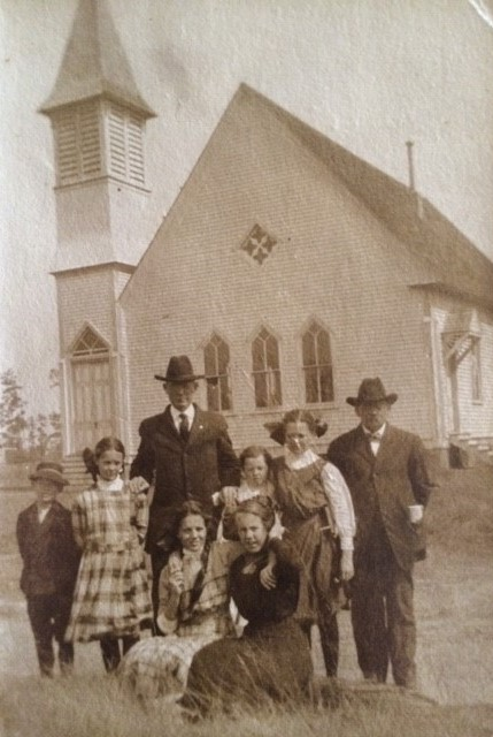
This is believed to be the oldest photograph of the church.
A Brief History of the Early Years
Our church is the outgrowth of camp meetings that began in this area, in the 1850’s. At some point, a log sanctuary called Shepard’s Church was constructed north of our current sanctuary. Daniel Shepard who served as the preacher, was an early settler and land owner whose log home stood where Grantwood Apartments are today, on Pauline Street. In 1875, Methodist Minister William Hargrove Morris began to preach here and at the other churches in the Powelton Charge. Powelton was a lumber industry boom town, between Gonzalez and Cantonment.
In 1876, young Walter Phelan Dickinson of Tuskegee, Alabama replaced Morris. On January 27, 1876, he met with Shepard, his wife Weltha, James Roberts and his wife, Frances, who deeded the sanctuary and property to the Methodist Church. The Shepards also donated land for a school. The original school was a small log structure north of the sanctuary. Pastor Dickinson was a former student of Professor James M. Tate also of Tuskegee. He invited his old teacher to consider becoming administrator of the school. Tate accepted and the school opened in 1878.
In 1885, the school was replaced with a large frame structure which had four large classrooms and was located near the current parsonage. It was the fifth public school in Escambia County, and the first public school outside of Pensacola. Designated Public School Number 5, it was eventually called Roberts School as was the community, church and cemetery. At the time, Gonzalez was north of the Lower Bluff Road (Old Chemstrand Road). Roberts extended south to Roberts Road (now East and West Roberts roads). Tate was administrator of the school from 1878 to 1913, when he retired. Tate was not a founding member of the church and he was never the minister in charge. He was an active Lay Minister and Justice of the Peace. He performed many weddings, baptisms and funerals over the years. The school was closed in 1916. It reopened at the current site in 1917 and was named James M. Tate Agricultural School in his honor.
In February 1897, at the quarterly conference, the decision was made to build a new sanctuary. To finance construction, at least two fund raisers were held. The first was held in May at the large home of church leader Thomas J. Davison, which stood on the southeast corner of what is now Pauline Street and Rusty Lane. Davison also purchased the original sanctuary which provided additional funds. The second fund raiser, held in August was a concert, performed at Roberts School. Admission was 25 cents and it was a huge success. The new sanctuary was completed in October and was located south of the original sanctuary. Davison then moved the original sanctuary to the north side of Rusty Lane across from his home, where it became the new Roberts Post Office. The post office was discontinued in 1910 and postal service was moved to Gonzalez. The old sanctuary was moved one last time, to the Vaughn property, where it ended its days as a hay barn.
By the 1930’s, the Roberts community had been absorbed by Gonzalez and the name of the church was changed from Roberts Methodist Church to Gonzalez Methodist Church. However, the cemetery was still called Roberts Cemetery. In 1968 the church became Gonzalez United Methodist Church. In 2023 the church withdrew from the United Methodist Church and joined the Global Methodist Church so, it is once again Gonzalez Methodist Church.
The 1897 Sanctuary has been modified several times over the years. In 1959 / 1960, the entire structure was modernized, altering both the interior and exterior appearance. Aluminum siding was added in the late 1970’s. Following damage caused by Hurricane Ivan in 2004, the interior was adaptively restored. Over the years, additional land has been donated and acquired. The campus has seen many changes, and the cemetery has endured, but the historic sanctuary remains the foundation for future growth and spiritual development.
Bob Bradley
January, 2026